02 The SIS and the NZ Police cover-up a case of manslaughter, CONFIRMED by the offender Eric (Louisa Marie) van der Lubbe. From Detective Colin Irvine all the way to the top.
THE REAL WANGANUI/NZ POLICE
YOU CAN TAKE THE BOY OUT OF THE GENE POOL, BUT YOU CAN’T TAKE THE FOOL GENE OUT OF THE BOY.
Perverting the course of justice #2 Just prior to the 1987 general election I happened to speak to Detective Colin Irvine at a Labour Party election meeting. I asked him if he was tooled up and he said, “discretely” and he then asked me a question about my brother Eric. I don’t remember the question but I do remember replying, “Why what’s he done?” Irvine shook his head and refused to say what Eric had done. My asking about his tool/firearm must have twigged his memory. Later Eric told me that a bloke had hassled him at a night club in Wellington/Porirua or thereabouts and Eric had pulled out his privately bought pistol (he thought he was James Bond) and had frightened the hassler off with it big time. He said, bloody good job that the bloke, in a panicked rush to get away, jumped over a wall, fell several meters and sustained fatal injuries on concrete below. He also said that Irvine was involved in the investigation (cover-up) and that Irvine was a real bastard. I remember seeing an item about the incident on TV (before Eric told me about it) and that the cops were appealing for witnesses. Eric lost his firearms licence, got the sack from his flash (double-nought spy) job at the Security Intelligence Service and got away with manslaughter because the SIS and the cops, including Irvine, engaged in a conspiracy to cover up Eric’s crimes so as to save both organizations the embarrassment of having to admit that SIS had employed a pistol-packin plonker. Makes the pie and the Playboy in the briefcase scandal seem a bit lame. It’s easy to see why Irvine was so relaxed about vilifying my (nobody) name to the Ombudsman and posterity. Eric’s crimes, manslaughter, presenting a firearm, unlawful possession of a loaded and restricted firearm. Bound to be a few more charges that would have been thrown at a non protected joe blogs. —————————————————————-
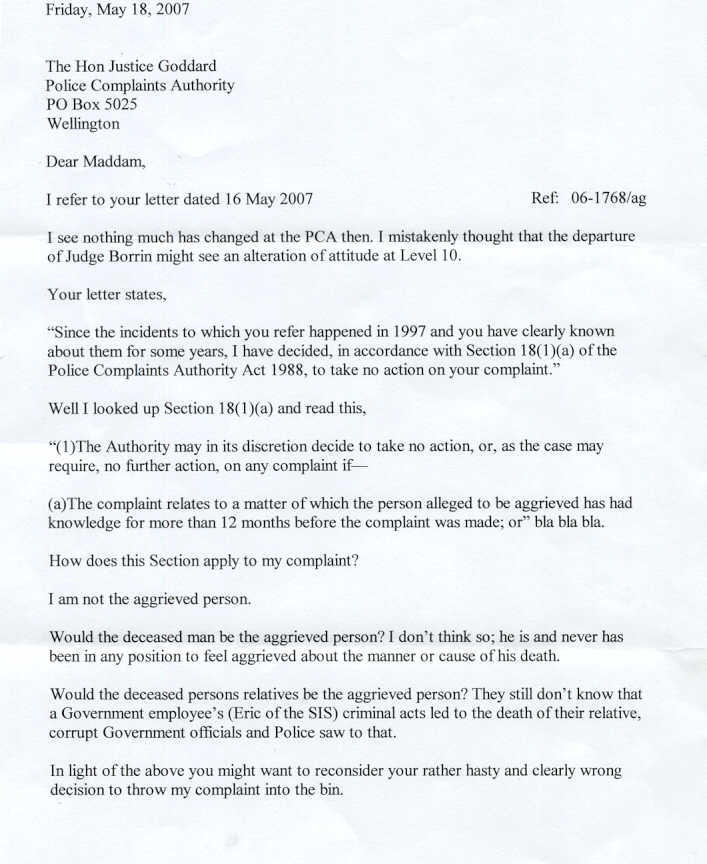
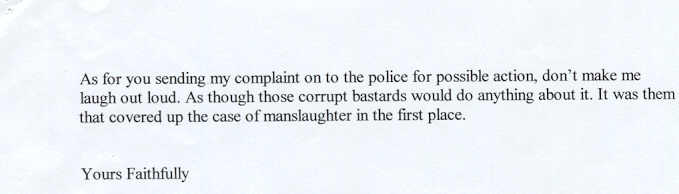
I made an emailed complaint about the above to the PCA, below is the reply. 
WHAT TRIGGERED OFF THAT LETTER YOU MAY ASK, ANOTHER FALSE ACCUSATION PERHAPS? The answer is at the bottom of the page.
http://www.kiwisfirst.com/judge-file-index/high-court-justice-lowell-goddard/
Louisa ( Eric ) van der Lubbe. said, on 19/03/2011 at 2:08 am (Edit)
Wow, I’m famous at last. However, dear bro I think you ought to own up to a couple of errors on this story.
The incident to which you refer happened when I caught a petty thief trying to steal the radio from my car and when I confronted him, he threatened violence. He changed his mind very quickly when I showed him the ( unloaded ) 9mm pistol I was carrying. I had, in fact been to a gunsmiths with it to have the grips changed and was on my way home. A perfectly legal operation.
Yes, the turd did run off and jump over a wall to escape, fell about 5 metres and ( probably ) broke a leg as he was still howling his head off when I drove away. Not dead as you claim and certainly not part of a cover up by the Police/SIS.
I suppose I should have called an ambulance but I was a bit annoyed at him at the time. In hindsight I should never have told you about it as you seem to have exaggerated the whole thing and it’s consequences…which were none in fact. I never heard another thing about it. I guess the turd crawled off and is still limping..I hope so anyway. I paid a lot of money for my car stereo!
To claim there was a death and subsequent cover up is absurd. The police would have been all over me like flies on shit for two reasons.
1: They never could stand the fact that a brother of yours was involved in law enforcement and later an officer in the SIS. That was aneathema to their credo that if one member of a family is a ” crim “, so must be all the others.
2: The police despise and envy the SIS because it used to be their job ” Special Branch ” They would have used any excuse to make the SIS look bad and would have plastered me all over the front pages of the Dominion and Evening Post with ” leaked ” reports. As they did with the agent who had his briefcase stolen from his car and ” left ” conveniently in the driveway of the house of a left wing reporter for the Evening Post. He must have annoyed a cop somehow.
Anyway… I have no desire to be implicated in something of that nature by my own brother simply because it furthers your interests….another example of how badly you have treated me during my whole life.
Remember smashing up my car while I was away with the army and covering that up…shame on you. I could go on for hours with other examples but why bother you have a good memory , if no conscience.
On with the real facts.
The reason for my forced resignation from the SIS was a fabricated offence under the Firearms act..granted..but no charges were ever laid or even considered. They resulted from a complaint from a massage parlour owner who was a police informant, who was actually acting in good faith. Strange but true, the police did act correctly and in a considerate manner and I have no beef with them. They were given false info which came from a normally reliable source and I cant blame them for that. That woman had her own agenda, that of protecting ” her ” girls from potential harm. I was, unkowningly, dating one of them and she was a bit freaked out with my owning handguns, which I enjoyed using in regional shooting competitions. She thought I was a crim….lol. (perceptive lady)
The internal watchdogs of the SIS are much more effective in digging up dirt however and they put me under surveillance and they discovered I was taking counselling in preparation for a sex change. You can imagine how well that went down..” laughs”
They put a blank paper in front of me and told me to write a letter of resignation, put me on an unofficial blacklist for any govt job, ever, and showed me the door. Nothing more, nothing less.
Still, working for them was the MOST boring job I’ve ever done, so no loss. I made much better money elsewhere and didn’t need to lie about my identity anymore.
I have absolutely nothing to hide anymore and revel in my freedom. The shopping in europe is wonderful and my passport doesn’t ring alarm bells in airports.
I’m happier now than ever except in finding that you are bullshitting about me. Stop that will you?….there’s a good chap.
I never had any dealings with Colin Irvine after leaving Wanganui so he has no input in this affair whatsover. I do think he is a bent cop though.
HE did come to see me at the MOT office before raiding your house and he did fish about for info on you which I found most amusing. I know you were never a drug dealer or involved in burglaries and I’ll defend you to the hilt on that even though I have a strong personal dislike for you.
I did tell Irvine that he was barking up the wrong tree but hey, when the cops get a name they aren’t happy until they have the whole family, down to the 3rd generation, locked up. They get quite fixated…goes with having a power trip.
Jack, I’m sorry that these things are following you to this extent but you seem to revel in the muck so I’ll not try to convince you to drop it all and start a new life elsewhere…..even in as much as it has worked for me and my family here.
For the rest of you… Jack has been definately dumped on from on high, unfairly and with considerable venom, by the NZ police, some of whose members are definately corrupt. They have been shown up on numerous occasions by Jack and they really dont like that. They’ll do anything they can to get him for that, no question.
If I was in Jack’s shoes, ( which I’d hate because I prefer mauve pumps to basketball boots ) I’d have packed up and left NZ years ago and good riddance to it.
Wait… I did !….he should do the same. No earthquakes here.
Lastly…Jack..remove this falsehood from this site. It hurts me emotionally but it hurts your credibility more. I have no axe to grind with you and I thought until today that I had sucessfully removed you from my life. Do us both a favour and either edit the story to tell the truth or delete it altogether.
The ” he thought he was James Bond ” comment cracked me up though… Jane Bond is more accurate.
cheers… Louisa… your sister. :-))))
________________________________
Jack said, on 20/03/2011 at 4:10 am (Edit)
The word fantasist came to mind when I read your dribble Eric. If you lied to me about why you got the sack from the SIS that’s your lookout. I’ve written what you told me at the time and I won’t be changing a word of it.
____________________
Jack said, on 22/03/2011 at 3:36 am (Edit)
You know if dopey Eric had kept his gob shut, stayed silent like Irvine and the SIS have done all these years, this matter would have remained inconclusive. But no, the “Wow, I’m famous at last.” fantasist couldn’t resist returning to the scene of the crime and confirmed for all to see that the “9mm pistol” incident did happen, that he was the offending gunman and that there were no “consequences” over the matter.
————————————————–
“I had, in fact been to a gunsmiths with it to have the grips changed and was on my way home. A perfectly legal operation.”
If you want anyone to believe that claim give us the name and address of the gunsmith and the date you allegedly visited him or are you another one of these forgetful types?
The day before he skipped NZ, leaving his sordid past, mounting debts and rubber cheques behind, ERIC burned his bridges with me by blaming me and my alleged criminality for his inability to get even the most demeaning “govt job.”
“They [SIS] put a blank paper in front of me and told me to write a letter of resignation, put me on an unofficial blacklist for any govt job, ever, and showed me the door. Nothing more, nothing less.”
Then, like the true coward he is, he blamed my alleged criminal proclivities for him being a penniless poser.
Hoist with his own petard!
++++++++++++++++++++++++++++++++++++++++++++++++++++++++++++++++++++

 Bent Cops
Wow, I’m famous at last. However, dear bro I think you ought to own up to a couple of errors on this story.
The incident to which you refer happened when I caught a petty thief trying to steal the radio from my car and when I confronted him, he threatened violence. He changed his mind very quickly when I showed him the ( unloaded ) 9mm pistol I was carrying. I had, in fact been to a gunsmiths with it to have the grips changed and was on my way home. A perfectly legal operation.
Yes, the turd did run off and jump over a wall to escape, fell about 5 metres and ( probably ) broke a leg as he was still howling his head off when I drove away. Not dead as you claim and certainly not part of a cover up by the Police/SIS.
I suppose I should have called an ambulance but I was a bit annoyed at him at the time. In hindsight I should never have told you about it as you seem to have exaggerated the whole thing and it’s consequences…which were none in fact. I never heard another thing about it. I guess the turd crawled off and is still limping..I hope so anyway. I paid a lot of money for my car stereo !
To claim there was a death and subsequent cover up is absurd. The police would have been all over me like flies on shit for two reasons.
1: They never could stand the fact that a brother of yours was involved in law enforcement and later an officer in the SIS. That was aneathema to their credo that if one member of a family is a ” crim “, so must be all the others.
2: The police despise and envy the SIS because it used to be their job ” Special Branch ” They would have used any excuse to make the SIS look bad and would have plastered me all over the front pages of the Dominion and Evening Post with ” leaked ” reports. As they did with the agent who had his briefcase stolen from his car and ” left ” conveniently in the driveway of the house of a left wing reporter for the Evening Post. He must have annoyed a cop somehow.
Anyway… I have no desire to be implicated in something of that nature by my own brother simply because it furthers your interests….another example of how badly you have treated me during my whole life.
Remember smashing up my car while I was away with the army and covering that up…shame on you. I could go on for hours with other examples but why bother..you have a good memory , if no conscience.
On with the real facts.
The reason for my forced resignation from the SIS was a fabricated offence under the Firearms act..granted..but no charges were ever laid or even considered. They resulted from a complaint from a massage parlour owner who was a police informant, who was actually acting in good faith. Strange but true, the police did act correctly and in a considerate manner and I have no beef with them. They were given false info which came from a normally reliable source and I cant blame them for that. That woman had her own agenda, that of protecting ” her ” girls from potential harm. I was, unkowningly, dating one of them and she was a bit freaked out with my owning handguns, which I enjoyed using in regional shooting competitions. She thought I was a crim….lol.
The internal watchdogs of the SIS are much more effective in digging up dirt however and they put me under surveillance and they discovered I was taking counselling in preparation for a sex change. You can imagine how well that went down..” laughs”
They put a blank paper in front of me and told me to write a letter of resignation, put me on an unofficial blacklist for any govt job, ever, and showed me the door. Nothing more, nothing less.
Still, working for them was the MOST boring job I’ve ever done, so no loss. I made much better money elsewhere and didn’t need to lie about my identity anymore.
I have absolutely nothing to hide anymore and revel in my freedom. The shopping in europe is wonderful and my passport doesn’t ring alarm bells in airports.
I’m happier now than ever except in finding that you are bullshitting about me. Stop that will you?….there’s a good chap.
I never had any dealings with Colin Irvine after leaving Wanganui so he has no input in this affair whatsover. I do think he is a bent cop though.
HE did come to see me at the MOT office before raiding your house and he did fish about for info on you which I found most amusing. I know you were never a drug dealer or involved in burglaries and I’ll defend you to the hilt on that even though I have a strong personal dislike for you.
I did tell Irvine that he was barking up the wrong tree but hey, when the cops get a name they aren’t happy until they have the whole family, down to the 3rd generation, locked up. They get quite fixated…goes with having a power trip.
Jack, I’m sorry that these things are following you to this extent but you seem to revel in the muck so I’ll not try to convince you to drop it all and start a new life elsewhere…..even in as much as it has worked for me and my family here.
For the rest of you… Jack has been definately dumped on from on high, unfairly and with considerable venom, by the NZ police, some of whose members are definately corrupt. They have been shown up on numerous occasions by Jack and they really dont like that. They’ll do anything they can to get him for that, no question.
If I was in Jack’s shoes, ( which I’d hate because I prefer mauve pumps to basketball boots ) I’d have packed up and left NZ years ago and good riddance to it.
Wait… I did !….he should do the same. No earthquakes here.
Lastly…Jack..remove this falsehood from this site. It hurts me emotionally but it hurts your credibility more. I have no axe to grind with you and I thought until today that I had sucessfully removed you from my life. Do us both a favour and either edit the story to tell the truth or delete it altogether.
The ” he thought he was James Bond ” comment cracked me up though… Jane Bond is more accurate.
cheers… Louisa… your sister. :-))))
@ joeblog… ” well thats pretty shame full eric be a man and let your fists do the talkin ”
Yeah right. The moron outweighed me by 3 stone and was holding a long electrical screwdriver. Why should I have taken any risks when scaring him off was enough? It was his choice to jump over the wall 50 metres from where I was standing by my car. The idiot. I wasn’t chasing him and even if the pistol was loaded I certainly would have missed him at that range. It aint like in the movies….
as for ” being a man “…well, you weren’t to know but even then I was in the process of changing my identity to the feminine. Being a man just didn’t work for me. 🙂
Even the police say you dont take on an armed offender. Not that they are ever around to do it themselves.
I have no shame over my actions nor in who I am, then or today. Before you judge someone, be prepared to walk in their shoes… or in my case.. Heels.
liked the rest of your comment though. Cheers. Louisa.
The word fantasist came to mind when I read your dribble Eric. If you lied to me about why you got the sack from the SIS that’s your lookout. I’ve written what you told me at the time and I won’t be changing a word of it.
You know if dopey Eric had kept his gob shut, stayed silent like Irvine and the SIS have done all these years, this matter would have remained inconclusive. But no, the “Wow, I’m famous at last.” fantasist couldn’t resist returning to the scene of the crime and confirmed for all to see that the “9mm pistol” incident did happen, that he was the offending gunman and that there were no “consequences” over the matter.
As Jack is guilty of ” Silencing posts ” among many other petty crimes hitherto undiscovered anything I post that will discredit him and his pathetic ramblings will never appear on this site. I welcome, however, the input of any Police officer who would like to investigate his claims prior to my contacting a lawyer to discuss a libel suit.
I dont live in fear so I can do that. 🙂
my email address is louisamvdl@hotmail.com. Feel free to drop me a line.
Louisa.
duh…. I dont have any secrets Jack. But you do, dont you Mr John Ross.
I never felt safe around you Jack, you’d steal the harness off a nightmare if you thought you could get away with it.
Your pathetic attempt to deny my legal and physical identity as Louisa is an indication of your twisted sexuality and homophobic/repressed fantasies.
You’ll have to do better than that, Mr Ross. That is the name on the false passport you use isn’t it? That can be checked on you know. Internal affairs keeps copies of applications and photos for passports.
Want to keep annoying me sonny?
Louisa Maire van der Lubbe.
ps.. I’ll be dumping the family name soon. You’ve dragged it through too much slime.
” Your secret was safe with me until you crapped in your own nest. But it’s not about you, it’s about Irvine and other bent cops who don’t care about truth or justice or haven’t you noticed. ”
Ok, So I wrote the story for you did I ?…. nothing is safe around you unless it’s welded to the floor. Even then you might lever it off with the screwdriver you stole from Craig Hooker. The long blue handled one. Yep, Mary saw it at your place. What a cunt thing to do, stealing from family.
It IS about me because you have attempted to drag my name into the slime in which you live.
” But you have admitted it DID happen Eric, albeit slightly different from your first boasting of it to me back in 88. ”
And you fell for it again. Bit like a shark..lol. You never learn do you?
I admit I lied about the whole thing from start to finish. Now admit you were wrong.
But you can’t now can you?…. what a giggle.
Admit it, you silly, paranoid old man… you’ve been suckered, right proper.
You even have to edit the posts I make that you aren’t too scared to publish.
Gutless as usual. Grow up or commit suicide. Hey, maybe you can make it look like the cops did it.
Louisa.
What is it with you and screwdrivers Eric? Oh I get it, you’re working on an insanity plea. You know you are your own worst enemy don’t you? Raving on about John Ross, rubber cheques, alleged family member rip-offs etc won’t alter the facts as I have outlined them above. Britton and Poynter did the same when they realised they had said too much. They made all manner of desperate (pathetic) accusations in vain attempts to intimidate me and extricate themselves from their self-inflicted predicaments. You have let the cat out of the bag with your hasty half-truths and inadvertently confirmed my allegations of a Police and SIS cover-up of your crimes. Get help Eric! PS I see you’re still as poor as an insolvent shoe salesman.